Depression treatment,
without medication.
FDA-cleared TMS therapy at our Pleasant Hill clinic — for adults with major depression or OCD who haven't responded to medication, or who can't tolerate antidepressant side effects.
Medically reviewed by Surender Punia, MD, ABPN Board-Certified Psychiatrist · Last reviewed May 2026
SMS appointment reminders are optional. You may opt in during booking — consent is not required to schedule or receive care. Msg & data rates may apply for opted-in numbers. Reply STOP to opt out anytime. See our SMS Consent & Terms.
Drug-free, non-invasive depression treatment.
Transcranial Magnetic Stimulation (TMS) uses targeted magnetic pulses to stimulate underactive areas of the brain associated with mood regulation.
It is FDA-cleared for major depressive disorder, OCD, and several other conditions — and unlike medication, it has no systemic side effects: no weight gain, no sexual dysfunction, no GI issues. TMS is typically a course of 30–36 sessions, five days a week for 6–8 weeks. Each session is about 19–37 minutes depending on the protocol. You are awake, alert, and can drive yourself home immediately after.
Universal Medical Group offers TMS at our Pleasant Hill clinic. If antidepressants haven't worked, or you can't tolerate the side effects, TMS is often the next step before considering Spravato.
Quick facts
- FDA cleared2008, for depression
- TypeNon-invasive, non-systemic
- Sessions30–36 over 6–8 weeks
- Per sessionRoughly 20–37 minutes
- AnesthesiaNone — fully awake
- Drive home?Yes, immediately
- InsuranceMost major plans
A pulse to the part of the brain that needs it.
TMS never enters the bloodstream — which is why it carries none of medication's systemic side effects. Instead, a magnetic coil rests lightly against the scalp and delivers brief, focused pulses.
Those pulses reach the dorsolateral prefrontal cortex — a region that tends to be underactive in depression. Repeated over a course of sessions, the stimulation is thought to gradually restore healthy activity across the brain's mood-regulating network.
Eligibility & indications.
TMS is most often used when medication hasn't been enough — or hasn't been tolerable. We screen every candidate thoroughly before starting.
Major depressive disorder
Adult MDD with inadequate response to at least one prior antidepressant trial at adequate dose and duration.
OCD
FDA-cleared deep TMS protocols for adults with obsessive-compulsive disorder.
Anxious depression
Major depression with prominent anxiety features — often the patients who do best with TMS.
Medication intolerance
Patients who can't tolerate antidepressant side effects — weight gain, sexual dysfunction, fatigue — often do well with TMS.
- Not a candidateTMS is contraindicated in patients with non-removable ferromagnetic metal in or near the head — for example aneurysm clips or cochlear implants. A history of seizure or significantly elevated seizure risk requires careful evaluation. We screen all candidates thoroughly before starting.
Your TMS course.
A predictable, step-by-step path — from the first evaluation through response tracking and, where helpful, maintenance.
Evaluation & mapping
The first visit (about 90 minutes) reviews history, prior treatments, and confirms TMS is the right step. We then perform a "motor threshold" — calibrating the TMS device to your specific brain anatomy.
Insurance authorization
We submit prior authorization. Most insurance covers TMS for MDD if you have tried at least one — sometimes two — antidepressants without adequate response.
Daily sessions, five times a week
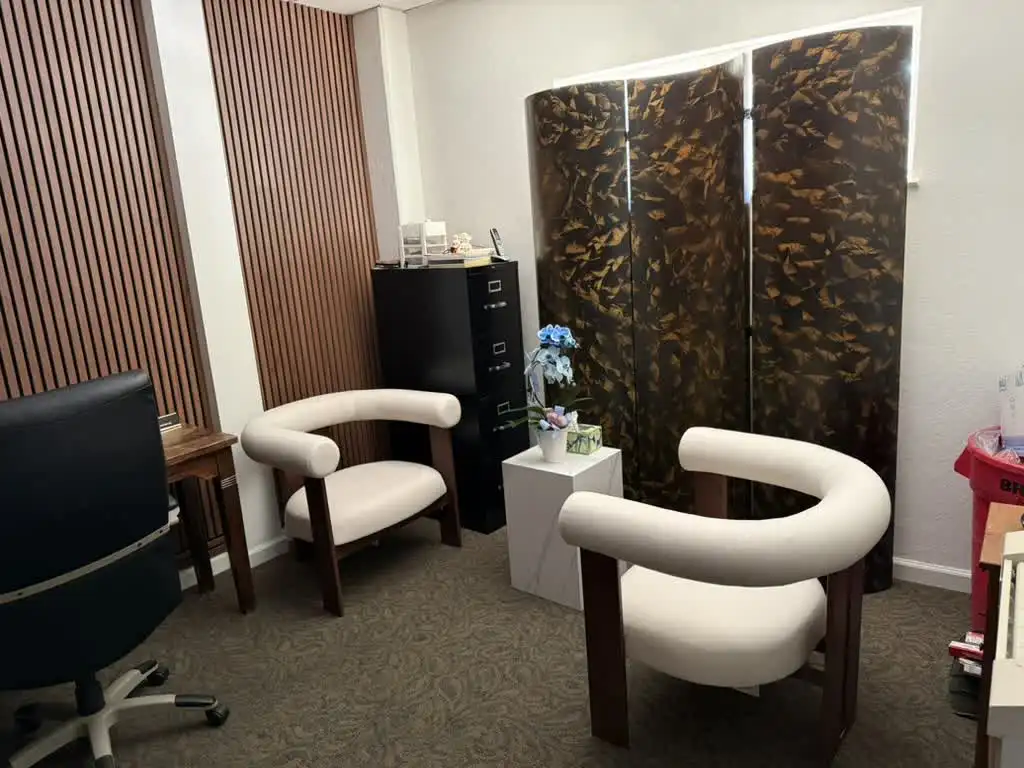
You come to our Pleasant Hill clinic each weekday for about 20–37 minutes. You sit in a comfortable chair, the device is positioned over your scalp, and the session begins. You can read, listen to music, or chat. No anesthesia, no recovery time.
Response tracking
We measure mood weekly using validated scales such as the PHQ-9. Most patients begin to feel meaningful improvement around weeks 3–4.
Maintenance or re-treatment
Many patients have lasting benefit after a single course. Some benefit from periodic maintenance sessions, or a re-treatment course later if symptoms return.
What to expect during & after.
TMS has one of the cleanest side-effect profiles of any depression treatment. There is no impact on memory, cognition, or alertness.
- Common & mildMild scalp discomfort or a tapping sensation during the session, a transient headache afterward — usually responsive to over-the-counter medication — and facial twitching during stimulation. Side effects typically fade after the first one to two weeks of treatment.
- Rare but seriousSeizure — estimated risk under 0.1% per course, and lower with proper screening. We screen for seizure risk factors before starting.
- No memory effectUnlike ECT, TMS does not require anesthesia, does not cause seizures by design, and has no effect on memory or cognition.
A comfortable, predictable daily visit.
All TMS treatments are administered at 91 Gregory Lane, Suite 20, Pleasant Hill, CA 94523 — Contra Costa County. Patients commute from across the East Bay — Walnut Creek, Concord, Lafayette, Orinda, Martinez — and our schedule accommodates early-morning and end-of-day slots, so most people don't need to take time off work.
TMS in Pleasant Hill — psychiatry statewide.
TMS is delivered in person at our Pleasant Hill clinic. Evaluation, medication review, and follow-up psychiatric care are available across all four California clinics and by TelePsychiatry statewide.
Pleasant Hill
91 Gregory Lane, Suite 20
Pleasant Hill, CA 94523 · Contra Costa County
TelePsychiatry
Secure video psychiatry from home
All 58 California counties
TMS FAQ.
From our team
TMS therapy — the drug-free, FDA-cleared treatment for depression you may not know about
Non-invasive, requires no anesthesia, and has no cognitive side effects. Patients drive themselves home after sessions.
What if your antidepressant isn't enough? The case for Spravato®
One in three people with depression don't respond to traditional antidepressants. Spravato® uses a different mechanism — often providing relief in hours, not weeks.
Clinical sources
The clinical information on this page reflects current guidance from national medical and government health authorities. Always consult a clinician about your individual care.
- National Institute of Mental Health. Brain Stimulation Therapies. nimh.nih.gov
- StatPearls, NCBI Bookshelf. Repetitive Transcranial Magnetic Stimulation. ncbi.nlm.nih.gov
- National Institute of Mental Health. Depression. nimh.nih.gov
If medication hasn't worked, there is another way.
Universal Medical Group offers FDA-cleared TMS therapy at our Pleasant Hill clinic for adults with treatment-resistant depression and OCD.
SMS appointment reminders are optional. You may opt in during booking — consent is not required to schedule or receive care. Msg & data rates may apply for opted-in numbers. Reply STOP to opt out anytime. See our SMS Consent & Terms.
'/%3E%3Cellipse%20cx%3D'40'%20cy%3D'80'%20rx%3D'30'%20ry%3D'20'%20fill%3D'%230F2E44'%20clip-path%3D'url(%23c)'/%3E%3Cpath%20d%3D'M18%2068%20Q25%2060%2040%2064%20Q55%2060%2062%2068%20L65%2080%20L15%2080Z'%20fill%3D'%231B4D6E'%20clip-path%3D'url(%23c)'/%3E%3Crect%20x%3D'34'%20y%3D'52'%20width%3D'12'%20height%3D'13'%20rx%3D'5'%20fill%3D'%23D4956A'/%3E%3Cellipse%20cx%3D'40'%20cy%3D'42'%20rx%3D'17'%20ry%3D'19'%20fill%3D'%23D4956A'/%3E%3Cellipse%20cx%3D'40'%20cy%3D'27'%20rx%3D'17'%20ry%3D'10'%20fill%3D'%233D2314'/%3E%3Cpath%20d%3D'M23%2032%20Q18%2044%2020%2058%20Q24%2062%2027%2060%20Q25%2050%2026%2038Z'%20fill%3D'%233D2314'/%3E%3Cpath%20d%3D'M57%2032%20Q62%2044%2060%2058%20Q56%2062%2053%2060%20Q55%2050%2054%2038Z'%20fill%3D'%233D2314'/%3E%3Cellipse%20cx%3D'33'%20cy%3D'42'%20rx%3D'4'%20ry%3D'4.2'%20fill%3D'%23fff'/%3E%3Cellipse%20cx%3D'47'%20cy%3D'42'%20rx%3D'4'%20ry%3D'4.2'%20fill%3D'%23fff'/%3E%3Cellipse%20cx%3D'33.4'%20cy%3D'42.2'%20rx%3D'2.8'%20ry%3D'3'%20fill%3D'%235C3317'/%3E%3Cellipse%20cx%3D'47.4'%20cy%3D'42.2'%20rx%3D'2.8'%20ry%3D'3'%20fill%3D'%235C3317'/%3E%3Cellipse%20cx%3D'33.8'%20cy%3D'41.6'%20rx%3D'1.4'%20ry%3D'1.5'%20fill%3D'%231a0a00'/%3E%3Cellipse%20cx%3D'47.8'%20cy%3D'41.6'%20rx%3D'1.4'%20ry%3D'1.5'%20fill%3D'%231a0a00'/%3E%3Ccircle%20cx%3D'34.5'%20cy%3D'41'%20r%3D'.7'%20fill%3D'%23fff'%20opacity%3D'.9'/%3E%3Ccircle%20cx%3D'48.5'%20cy%3D'41'%20r%3D'.7'%20fill%3D'%23fff'%20opacity%3D'.9'/%3E%3Cpath%20d%3D'M28%2037.5%20Q33%2035.5%2038%2037'%20stroke%3D'%233D2314'%20stroke-width%3D'1.5'%20fill%3D'none'%20stroke-linecap%3D'round'/%3E%3Cpath%20d%3D'M42%2037%20Q47%2035.5%2052%2037.5'%20stroke%3D'%233D2314'%20stroke-width%3D'1.5'%20fill%3D'none'%20stroke-linecap%3D'round'/%3E%3Cpath%20d%3D'M33.5%2052.5%20Q40%2057.5%2046.5%2052.5'%20stroke%3D'%23C4845A'%20stroke-width%3D'1.5'%20fill%3D'none'%20stroke-linecap%3D'round'/%3E%3Cellipse%20cx%3D'28'%20cy%3D'49'%20rx%3D'4.5'%20ry%3D'2.5'%20fill%3D'%23E8967A'%20opacity%3D'.28'/%3E%3Cellipse%20cx%3D'52'%20cy%3D'49'%20rx%3D'4.5'%20ry%3D'2.5'%20fill%3D'%23E8967A'%20opacity%3D'.28'/%3E%3C/svg%3E)